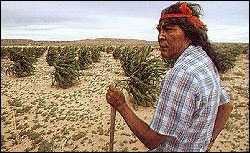
| The main food of the Hopi is corn. According to mythological tradition, during the transition to the fourth world, the Great Spirit and the Spider Woman gave the humans various varieties of maize, which differed greatly in colour and size. The Hopi were the last to choose their food for this world. They chose the smallest blue corn variety. Massau said: By this choice you have shown me that you are wise and humble. Therefore you will be called Hopi and I will give all land and life into your care so that you will guard, protect and preserve it until the last days of return come". |
|
Thus, for the Hopi people, corn was an everlasting spiritual reminder of this place and its mission in this world. This is the only way to understand that for hundreds of years the Hopi have been living in a settlement area that was considered completely barren for all other people, due to its poor climatic conditions (low rainfall, dry winds, large temperature fluctuations, hot wasteland climate in summer, etc.). The Hopi developed from their deep inner faith a special processing method called "dry management". Maize and bean fields are mainly planted at the foot of the mesas so that the roots of the plants can reach the rare groundwater as optimally as possible. The families have many small fields in different positions to ensure that at least one field is enough to survive the harvest. Traditionally, the Hopi do not plough their fields to cause Mother Earth as few injuries as possible. Between the plantations in their fields, rows of natural vegetation grow in order to balance the soil and not to separate the "corn plants" too much from their other "plant sisters and brothers". The seed of the maize is sunk into the soil by means of long gravesticks in order to preserve the soil as much as possible and to supply the seed in the depth of the moisture.
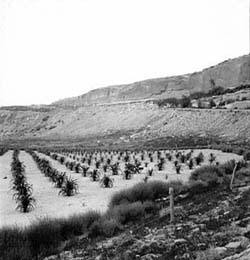
The humble perseverance in this barren wasteland and the daily existential struggle for food can only be explained by the deep religious rootedness and trust of the Hopi in their holy land, Mother Earth and in their helping creative spirit Massau. As a representative of the nourishing and protective energy of maize, the Hopi worship the maize mother, who was introduced very early into the life of the growing toddler as a "toy doll".