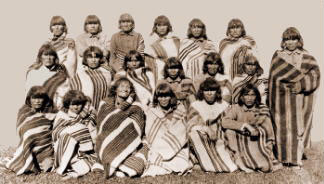
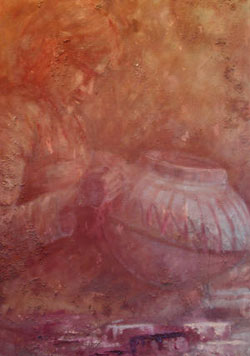
| The Hopi art covers the whole range from ceramics and jewellery to woven baskets and woven blankets. The Hopi women are mainly responsible for the production of pottery and wickerwork. The colours and symbolic forms used have traditionally been handed down from time immemorial and must not be changed. They can be traced back to original symbols that play an important role in the creation history of the Hopi (the spiral, the turtle as symbol animal of the continent, Mother Earth, the rainbow and the rain clouds, Father Sky, etc.). Thus, these works of art are not only beautiful objects of daily use, but recurring memories of religion and the roots of their own people. |
|
The Hopi men weave, make silver jewellery and carve the so-called Katchina figures. Katchinas are helpful Hopi spirit beings who assist them in many areas of life and whose embodiment in the dolls is often used for ceremonial purposes. In order to familiarize the children with these spiritual beings as early as possible and to introduce them to the multilayered meaning of the Katchinas, they are given various Katchina dolls from an early age. This is not a toy, but an initiation aid in the spiritual education of children. The katchinas that can be seen in museums, for example, are always faulty or defective specimens that cannot be used for spiritual purposes for this reason.
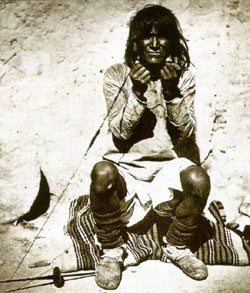
| At Hopi, the men are responsible for making the yarns and thus the fabrics from which the traditional garments are made in the families. In the early days the yarn was spun from fibres and animal hair with the fingers, nowadays cotton and wool are used to a large extent. The traditional dress of women is called "Manta". It is a rectangular piece of fabric that is attached to a black undergarment on the right shoulder and swung loosely over the left arm. The colour of the clothes is determined by the colours black, red and white, which symbolically reflect the powers of Mother Earth. |
|
The Hopi men's clothing was traditionally very simple: a narrow strip of beautifully patterned fabric was passed between the legs and tied at the waist by a strap, so that long pieces of fabric hung down at the front and back. The upper body was free, only later traditional shirts with beautifully woven patterns and symbols developed, which as in pottery and weaving were reduced to traditional forms. In the cold of winter, beautifully woven blankets were used for warmth and protection.
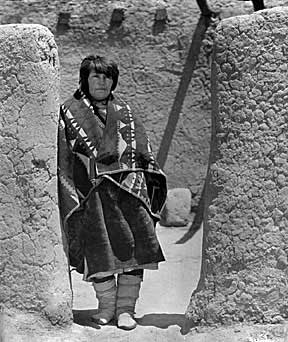
Certain details and dress details indicate membership in a particular clan or ceremonial group.
Clothes and masks play an important role in the ceremonial dances and festivities that play an important role in Hopi culture. In this way, contact is established in a shamanistic sense with the various spirits and beings that are to be invoked in the individual ceremonies.